Showing posts with label Italian. Show all posts

Sunday, May 20, 2012

Grilled Cheese ... Pizza

I love the kind of pizza they make in the Boston area. It is similar to New York-style pizza. It is generally a thin crust, but not like Pizza Hut's thin crust. This kind of pizza is cooked in a very hot oven, it could be as hot as 800-900 degrees in a brick oven. (I saw something on the Food Network about a New York pizzeria that has an oven fueled by coal that gets up to 2,000 degrees.)

Because the oven is so hot, the pizza cooks quickly, and there is a char on the crust. I like this kind of pizza crust. I am not fond of the conveyor-belt ovens that most of the chain restaurants use. I spoke with an owner of a small, regional pizza chain, and he preferred the conveyor-belt ovens because they provide a consistent temperature and do not have to recover from the frequent opening and closing of the oven door.

Thanks to Peter Reinhart, author of "American Pie: My Search for the Perfect Pizza," I discovered a way to get the charred crust, even if my home oven can only reach a temperature of 550 degrees. The solution? Grill it.

I had never heard of grilled pizza until I read the Reinhart book. I've tried it a few times, and I have good results. Have purchased (and built) a new grill a couple of days ago, I am making sure I get my money's worth. In the three days we have had it, we've used it four times: 1) Hamburgers on Friday night; 2) hamburgers on Saturday night; 3) bratwurst for lunch on Sunday (and also cooked some country ribs, using indirect heat) and 4) grilled pizza for dinner Sunday night.

Here is a dough recipe I have used in the past:

Dough:

3 cups unbleached, all-purpose flour

1-1 1/2 cups warm water

1 Tbsp instant yeast

1 Tbsp sugar

2 tsp Kosher salt

1 Tbps olive oil

I put everything in the bowl except the water, and then I added 1 cup of water. It needed a little more, so I added some. I actually stirred everything with a wooden spoon until the dough formed, and I next kneaded it for a couple of minutes. I did not work the dough a lot. I formed it into a ball and placed it back into the bowl and covered it with a tea towel. After about an hour I punched it down and reformed it into a ball. Covered and waited until I was ready to cook dinner.

If you want to check out a Reinhart dough recipe, click here. You can also try America's Test Kitchen's version of a New York-style pizza here. I followed America's Test Kitchen's decision to go with cold water instead of warm and allow the dough to rise over a few days, but I do not measure the flour and water. I've been making dough long enough that I can go by feel.

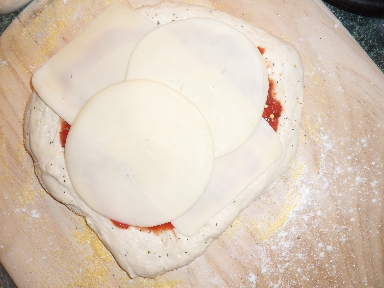
When you grill pizza, it is important to use a small, thin crust because it will cook quickly. Look at the photos above, and you will see the crust chars easily. I am not well-versed in grilling pizza because I like cheese pizzas. I will give you a run-down of how I make my grilled pizza and offer some suggestions if you decide to try it.

From the above batch of dough (after it was allowed to rise and ferment in a resealable, zipper-style plastic bag over three days), I divided into four equal portions, rolled them out on a floured surface and covered them with plastic wrap. The dough balls rose for about an hour.

I rolled each ball out to make a think crust; sprayed a wire, mesh screen used for vegetables with olive oil; and placed the crust on the screen. The crust is then cooked over a high heat on the grill for a couple of minutes. Once the bottom half of the crust is done, take it off and add sauce and toppings.

If you use a sauce (as opposed to sliced, diced or crushed tomatoes), use very little sauce. The pizza cooks too quickly, so a lot of sauce will minimize the melting of the cheese. I have firsthand knowledge of this. Another mistake I made was to use sliced cheese instead of shredded cheese. It took longer for it to melt.

Now, here is the portion of the blog where I offer suggestions. Use sauce sparingly. Use shredded cheese and less than you normally would on a regular pizza cooked in the oven. I was going to use pepperoni, but ultimately decided against it because of how quickly the pizza cooks. If you use toppings, try sauteeing them first, so you are putting on cooked toppings instead of ones that need to cook.

My grilled, cheese pizzas turned out pretty good, but they could have been a little better. I did enjoy the charred crust, though. Try grilling pizza, you'll like it. (And to learn more, check out Reinhart's book.)

Saturday, March 12, 2011

Pizza my way

Growing up in an Italian family in an Italian neighborhood in Revere, Mass., I have been exposed to a lot of good Italian food and pizza. I love pizza, but not just any pizza. It's the style that is often referred to as New York-style pizza, though I might argue it's Boston's style, too.

The four-ingredient dough
It involves a dough that is made one day and allowed to slowly rise and ferment in order to have it ready for use the next day. The dough I now use is the one from the book, Artisan Bread in 5 Minutes a Day. It is made from four ingredients: Flour, yeast, salt and water. My wife, Wendi, borrowed the book from the Wayne County Public Library, and we fell in love with it. At first, we just made bread with it. However, the first time Wendi made pizza with it, I absolutely loved it.
The texture, the crisp, chewy crust and the flavor brought me back home to Revere (we now live in Wooster, Ohio). The pizza was incredible; one of the best I had in a long time. Wendi, on the other hand, did not like it as much. She grew up with a different style of pizza. Guess that's her loss.

The 'uncooked' sauce
When making a pizza for me, I prefer an uncooked sauce. To me, it provides a more engaging, robust flavor than tomatoes that have been mellowed by a long simmer. I used crushed tomatoes from a can. I have tried diced and petite diced, but I prefer the crushed tomatoes. Seems like the only way I find crushed tomatoes anymore is in puree, not my first choice, but not bad. To make my "sauce," I spread the crushed tomatoes over the hand-stretched dough (which I put on a wooden pizza peel that has on it a liberal dose of corn meal). I sprinkle on the tomatoes: Salt, pepper, garlic, oregano, basil, parsley (all dried herbs) and sugar. Don't ask me for measurements, just sprinkle the ingredients on, but not too much. The sauce will cook in the oven.

Sliced mozzarella and provolone
I am a big fan of cheese pizza. I don't need any toppings (though pepperoni and bacon is a great combination, but don't put the bacon on raw ... leaves too much grease, don't ask me how I know, but I do. Trust me). I stay away from fresh mozzarella and mozzarella balls because they have more moisture than I want for my pizza. I do not use shredded cheese, either. I do not buy already shredded cheese (way too dry), and I do not shred it myself. I like using sliced cheese, a combination of mozzarella and provolone. I buy mine at East Union Bulk Food Store outside of Wooster, and I pay around $2.99 per pound for each.

Why cook pizza on a pan?
That's about it, except for the heat. The New York- and Boston-style pizzas are generally cooked in brick ovens at an extremely high heat (think perhaps 800-900 degrees, however, I heard of a pizzeria in New York that uses coal and gets up to 2,000 degrees). The high heat allows for the pizza to cook quickly, and it gives the dough a nice char, which adds flavor. I cannot achieve such temperatures at home. My oven maxes out at 550 degrees. But, I do preheat the oven for about an hour before I am ready to make the pizza; it gets the oven nice and toasty, and it brings the pizza stones in the oven up to temperature. When cooking pizza for me (as opposed to for Wendi and me or family and friends), it goes on the stone. Sometimes I start it on a pizza screen and then move it to a stone, but I do not like cooking it on a pan.

I should have let the dough rest.
So, I recently used some of Wendi's dough to make a pizza. Everything went well, except for one thing. I did not have the patience to allow the dough time to come to room temperature and raise a little bit. Wendi makes the dough ahead of time and keeps it in the fridge. We pull off what we need for a loaf or a pizza and put the rest back in the refrigerator. So, as you can see from the adjoining picture, I got nice char, the cheese melted nicely, but there was just too much lift in the dough. Because the crust rose a lot in the oven, the crushed tomatoes pooled to the middle, creating a relatively dry outer ring on the pizza and a tasty, saucy middle. The middle had incredible flavor, but the outer edge was just too dry.

The good news is Wendi has made another batch of dough, so I will go at it again.

Friday, March 4, 2011

So, why a food blog?


Other than Bryan Schaaf suggested it, right?

My mother is Italian, and my father was a chef. The two are great cooks.

Whenever I have been out to eat at Italian restaurants and my friends raved about the food, I would say something like this, "It's OK. I grew up eating this stuff." The question du jour became, "Is it better than my mother's?"

My mother, Carmen Mercuri, is incredible at cooking Italian food, her specialty. My father, Bob Warren, was great at all sorts of American cuisine. I learned a lot about cooking and proper food prep and storage from him.

I ended up working for my father at Valle's Steak House in Daytona Beach and later at Girves' Brown Derby (after the company purchased Valle's building). Other restaurants included Lovece's Pizza Palace, the restaurant at Pelican Bay Country Club and Casa Gallardo's Mexican Restaurant. I had the opportunity to learn about cooking ethnic foods, American cuisine, seafood (even though I do not eat it), broiling steaks, deep frying foods, butchering, baking and more. I discovered I love to cook.

A former manager, Jere Main, told me that if I knew how to cook, then I would always have a job. Glad to say I have not had to cook in a restaurant for quite some time; it is hard work -- hot, sweaty, greasy, long time standing on your feet. I wouldn't mind cooking in a test kitchen or something, but I don't think I am up to restaurant work anymore.

So, let's have some fun. I'll share some recipes (but I warn you, I cook like my mother ... don't really measure stuff, pinch of this, some of that, check the consistency, if too thick, add milk, etc.

Tonight, I made some Certified Angus Beef rib-eye steaks. (Ordered them from Buehler's online). Now, they label them rib-eye steaks, however, I always thought if the cap was still on, it was a Delmonico; cap off, rib-eye. Sprinkled seasoned salt and cracked black pepper, and I cooked them in a moderately hot cast-iron skillet. Cooked them between rare and medium rare. They were incredible.

For a side dish, I threw together an al fredo dish using radiatore pasta; I like the way the curled pasta captures and holds the sauce. For the al fredo sauce, I heated a tablespoon of butter in a pan, and when it melted added about a teaspoon of minced garlic (I don't use fresh). Next, I tossed in about one-and-a-half tablespoons of flour to make a roux, and added one-and-a-half cups of half-and-half. As the sauce thickened, I seasoned it with about a teaspoon, maybe a little more, of salt and sprinkled in some cracked black pepper. I melted in about two teaspoons of butter and tossed in about 2 ounces of shredded parmesan cheese and about 2 ounces of grated parmesan cheese (yeah, the stuff that comes in a plastic container).

That was it. I should have taken some photos, but forgot. I'm new at this food stuff. I'll get in gear. The al fredo was OK; wished I would have had more shredded parmesan. Also, I generally add granulated garlic, too, but I did not this time. All in all, not bad. Steaks were great.